
The return to autumn sports often comes with a challenge well known to our physiotherapists: a knee that “gives way,” lacks stability during sudden changes of direction, or remains tender from a past injury. Choosing the right knee brace can make a significant difference, provided it matches your specific joint mechanics and clinical needs.
Targeted physical therapy combined with a properly fitted knee brace helps:
- Support knee joints presenting with structural or functional ligamentous instability
- Reduce the risk of reinjury following a previous sprain or reconstructive surgery
- Facilitate a safer, faster return to sport during the back-to-school and autumn transition
- Correct underlying muscle imbalances that exacerbate dynamic joint instability
- Guide you through the market, matching your specific profile with the optimal bracing technology
Why does a knee become unstable?
Before selecting a knee brace, it is essential to understand the root cause of joint instability. The knee is a hinge-like joint with minimal bony congruence; its structural stability depends almost entirely on its surrounding ligaments and the dynamic neuromuscular control of surrounding muscles. When any of these components are compromised, the joint loses its reliability.
The role of the cruciate ligaments
At the center of the knee joint, two primary ligaments cross each other:
- Anterior Cruciate Ligament (ACL): prevents the tibia (shinbone) from sliding forward beneath the femur (thighbone) and controls rotational forces during pivoting movements. ACL injuries are by far the most common among athletes and typically manifest as a knee that “gives way” during sudden direction changes.
- Posterior Cruciate Ligament (PCL): considerably thicker and stronger than the ACL, the PCL prevents the tibia from displacing backward relative to the femur.
Incompletely rehabilitated knee sprains
A knee sprain may appear fully healed once localized pain disappears, but functional recovery is often incomplete. Without comprehensive physical therapy, joint proprioception, muscular strength, and reactive reflexes remain impaired. Additionally, stretched ligamentous tissue may retain structural laxity. While such a knee may tolerate normal walking without issue, it frequently buckles under high demand or sudden multi-planar movements.
Muscular weakness: an overlooked factor
The quadriceps serve as the primary dynamic shock absorber and stabilizer for the knee. Following an injury, quadriceps activation drops rapidly due to arthrogenic muscle inhibition, and recovery requires targeted retraining.
Simultaneously, hip stabilizers – especially the gluteus medius – control the alignment of the entire lower extremity. Weak hip abductors allow the knee to collapse inward (dynamic knee valgus) during jump landings, cutting maneuvers, or running strides, drastically increasing tensile stress on the ACL and MCL.
Knee osteoarthritis
Joint instability is not limited to young competitive athletes. Cartilage wear associated with knee osteoarthritis alters joint mechanics, causes reflex muscle inhibition due to pain, and generates a feeling of a “weak” or unpredictable knee – particularly when negotiating stairs or walking on uneven ground.
High-risk sports for knee instability
Certain athletic activities place immense rotational torque and impact loads on the knee joint:
- Pivoting & Cutting Sports: Soccer, basketball, volleyball, tennis
- Contact & Collision Sports: Hockey, football, rugby
- Alpine Sports: Skiing, where the long lever arm of the ski can impart high twisting forces to the flexed knee
These sports represent the vast majority of clinical scenarios where specialized functional knee bracing is recommended.
Primary categories of knee braces and orthoses
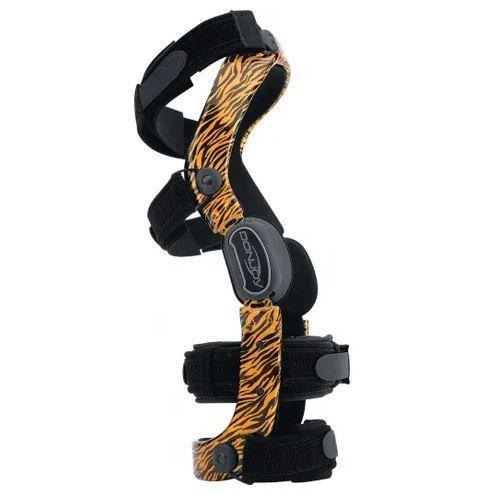
AMS Clinics knee brace
A wide variety of knee supports exist – ranging from basic off-the-shelf elastic sleeves to custom-fabricated hinged carbon-fiber frames. Each category addresses specific biomechanical demands. AMS Clinics offers a complete selection of specialized knee braces and orthopedic appliances tailored to individual patient needs.
Prophylactic knee braces
Worn primarily as a preventive measure by athletes with no prior history of ligament damage, prophylactic braces are common in high-impact contact sports (such as football linemen). Their primary objective is to absorb and deflect direct lateral impacts to the outer knee, reducing the severity of MCL sprains.
Clinical Note: Prophylactic bracing does not replace dynamic muscle strength or pre-season athletic conditioning.
Functional knee braces
Functional braces are engineered for knees with diagnosed structural ligament deficiencies – such as non-operative ACL/MCL tears or athletes returning to pivoting sports following ACL reconstruction (ACLR). Built with rigid aluminum or carbon-fiber frames and dynamic polycentric side hinges, functional braces restrict abnormal anterior tibial translation and rotational torque during explosive athletic movements.
Post-operative and rehabilitative braces
Designed for acute post-surgical care or immediate post-injury immobilisation, rehabilitative braces feature full-length rigid struts and adjustable Range of Motion (ROM) hinges. These hinges allow physical therapists and orthopedic surgeons to dial in precise flexion and extension limits, protecting healing graft or ligament tissue while gradually advancing movement throughout rehabilitation.
General support sleeves and unloader braces
- Neoprene and elastic compression sleeves: lightweight and flexible, compression sleeves suit minor patellofemoral tracking issues, mild generalized aches, or minor swelling. While they provide minimal structural ligament stability, they enhance joint proprioception and local thermal warmth.
- Unloader (offloading) osteoarthritis braces: specifically designed for unicompartmental knee osteoarthritis, unloader braces apply a corrective 3-point bending force to shift mechanical loads away from the damaged compartment (medial or lateral) onto healthier cartilage, significantly decreasing weight-bearing pain.
Frame rigidity and hinge alignment: critical clinical details
A brace’s overall effectiveness depends heavily on precise fit and biomechanical alignment:
- Frame rigidity: The frame material must match the level of force generated by the athlete’s activity level.
- Polycentric hinge alignment: Side hinges must track perfectly with the knee’s anatomical axis of rotation.
A misaligned hinge can slip during exertion, restrict natural knee flexion, cause skin breakdown, or fail to block the exact pathological movement it was prescribed to control. While functional, post-operative, and unloader braces deliver the highest mechanical support, their success depends on accurate fitting and individualized clinical evaluation.
Watch the video below for a step-by-step fitting guide for the M Brace #41 hinged knee brace.
How to choose the right knee brace for your specific situation
There is no single “best” knee brace in absolute terms – only an orthosis that matches a specific knee joint, a precise clinical diagnosis, and an individual’s physical activity demands. Our registered physical therapists consider several key criteria when recommending bracing solutions, though this guide cannot replace a comprehensive professional evaluation.
-
Begin with a precise clinical diagnosis
Relying solely on subjective sensation is risky. A feeling of joint instability can originate from a torn ligament, a meniscal lesion, patellofemoral tracking dysfunction, or isolated muscular weakness – and each underlying cause requires a entirely different therapeutic approach. A professional assessment identifies the exact anatomical structure at fault before you invest in an expensive brace.
-
Match your sport and movement demands
A soccer midfielder who pivots constantly, a long-distance trail runner, and an alpine skier experience completely different biomechanical loads. Brace selection must account for the most demanding movements required by your activity:
- Rapid multidirectional cutting and pivoting
- High-impact jump landings
- Sudden deceleration and braking
- Lateral contact forces and rotational torsion
-
Evaluate Daily Versus Activity-Specific Instability
A knee that buckles while simply walking down stairs or navigating uneven terrain presents a different clinical challenge than a knee that gives way only during explosive sprinting or pivoting. The frequency and severity of instability dictate whether you require a lightweight, proprioceptive compression sleeve or a rigid, high-support functional brace.
-
Demand a precise, custom fit
For genuine ligamentous instability, proper fit and sizing are non-negotiable. A knee brace that migrates, slips down the calf, or fails to mirror the leg’s natural contour loses its mechanical advantage. Professionally measured and custom-fabricated carbon-fiber braces remain securely anchored during intense athletic exertion, delivering counter-force precisely where it is needed.
-
Integrate bracing with active muscle strengthening
A knee brace should never serve as a permanent crutch. Orthopedic bracing yields the best clinical outcomes when combined with an active physical therapy program focused on targeted quadriceps, hamstring, and gluteal muscle strengthening.
Does a knee brace alone suffice?
An orthopedic knee brace is a valuable supportive tool, but it is not a complete standalone solution. While it temporarily compensates for structural instability, it does not correct the underlying mechanical drivers that caused the vulnerability in the first place.
Strengthening the muscles that actively protect the knee
The quadriceps, hamstrings, and hip stabilizers form your knee’s true line of active defense. The hamstrings, in particular, serve as vital synergists to the anterior cruciate ligament (ACL) by pulling the tibia backward relative to the femur. A structured, progressive rehabilitation program restores ideal force production and strength balance across these muscle groups.
Proprioception for rapid reflex control
Raw strength is insufficient if your muscles fail to fire at the exact millisecond an imbalance occurs. Proprioceptive training – using single-leg stances, unstable surfaces, and controlled multidirectional agility drills – trains the nervous system to react instantly to sudden shifts in terrain or momentum. This rapid neuromuscular reflex arc is what ultimately protects the ligament during explosive pivots or jump landings.
Avoiding bracing dependency
When worn without active rehabilitation, a knee brace can create a false sense of security. Some individuals become psychologically dependent on the brace, refusing to move without it while their underlying supporting musculature continues to atrophy from disuse.
The ultimate clinical objective is for the knee to regain independent stability, utilizing the brace strictly as tactical external support during high-demand athletic activities.
A progressive and safe return-to-sport plan
Partnering with a registered physical therapist ensures a structured, phase-based return to athletic activity:
- Restoring Joint Range of Motion and Pain-Free Mobility
- Rebuilding Concentric and Eccentric Strength
- Refining Balance and Neuromuscular Proprioception
- Progressing to Linear Running, Agility Drills, and Sport-Specific Movements
Each functional milestone is clinically validated before advancing to the next phase. Our physiotherapist team evaluates your knee mechanics, guides your rehabilitation, and prescribes the exact orthosis best suited to your sport and clinical profile.
Frequently Asked Questions
How do I know if my knee actually requires a brace?
A repeated feeling of joint instability – especially during sudden direction changes, cutting movements, or while negotiating stairs – is a clear indicator that a clinical assessment is needed. A registered physical therapist evaluates whether the instability stems from structural ligamentous laxity, dynamic muscle weakness, or a combination of both, while ruling out underlying meniscal tears or cartilage lesions.
Is an over-the-counter knee brace sufficient, or do I need a custom model?
The choice depends directly on the severity of joint instability and your specific sport demands:
- Over-the-counter braces: Suitable for mild swelling, light structural support, or generalized pain management during low-impact activities.
- Custom functional braces: Required for diagnosed ligament ruptures (such as ACL or MCL tears) and high-impact pivoting sports to deliver exact anatomical tracking and rigid torque control.
- Clinical guidance: A physical therapist verifies the exact level of support your joint profile requires before you make an investment.
Is it safe to play sports while wearing a knee brace?
Yes, in the vast majority of cases – provided the orthosis is accurately matched to your diagnosis and sport. A poorly chosen or ill-fitting brace can create a false sense of security without delivering actual mechanical support. Obtaining a professional fitting before returning to pivoting or contact sports is essential to ensure true joint protection.
How long should I wear a knee brace after a knee injury?
The duration depends on injury severity, tissue healing stages, and rehabilitation progress:
- Return-to-sport phase: Many athletes wear a functional brace strictly during high-demand training or competitive play.
- Long-term preventive use: Recommended for high-risk pivoting or contact sports following major reconstructive surgeries.
- Progressive weaning: Your physical therapist adjusts brace usage based on objective functional strength and balance metrics achieved during rehab.
Can muscle strengthening completely replace wearing a knee brace?
In mild cases driven primarily by muscle weakness, a targeted strengthening program may fully stabilize the joint without requiring an external brace. However, for moderate-to-severe ligamentous laxity, muscular strengthening and functional bracing are complementary rather than interchangeable. A physical therapist determines whether active conditioning alone or a combined approach yields the safest outcome for your knee.
Author
-
We are physiotherapists passionate about movement and rehabilitation, with a clear goal: helping people better understand their pain and return to an active, unrestricted life.
Through our practice and content, we share practical, science-based approaches to prevent injuries, relieve pain, and sustainably improve mobility. We believe that well-informed patients make better decisions and achieve better outcomes.

Richard Bouzaglou, B.Sc. PT
Physiotherapist | Co-Founder
An experienced professional, Richard is the co-founder of the AMS Medical and Rehabilitation Center, where he has played a key role since 2008. With a background in sports medicine and physiotherapy, he has developed strong clinical expertise, particularly working with elite athletes.
His practice is based on a comprehensive approach that integrates advanced manual therapy, functional rehabilitation, and personalized care. Committed to continuous education and mentoring students, he is known for his clinical rigor and his ability to build lasting, trust-based relationships with his patients.

Moshe Vazana
Physiotherapist
With over 15 years of experience, Moshe is recognized for his precise, evidence-based approach. A physiotherapy graduate with advanced training in several methodologies, including the McKenzie Method (MDT) and the Mulligan Concept, he specializes in treating musculoskeletal and spinal conditions.
His international background and commitment to excellence enable him to provide care that is tailored, effective, and sustainable. Passionate about knowledge sharing, he is also actively involved in training the next generation of physiotherapy professionals.
Recent Comments