
Can Physiotherapy Help Avoid Surgery for a Herniated Disc?
In the vast majority of herniated disc cases, surgery is not inevitable. Physiotherapy is a first-line treatment that can reduce pain, restore mobility, and help patients return to their normal activities without surgery.
Physiotherapy can help:
- reduce pressure on the compressed nerve;
- strengthen the muscles that stabilize the spine;
- restore mobility in the lumbar or cervical spine;
- teach patients which postures and movements to adopt;
- prevent long-term recurrences.
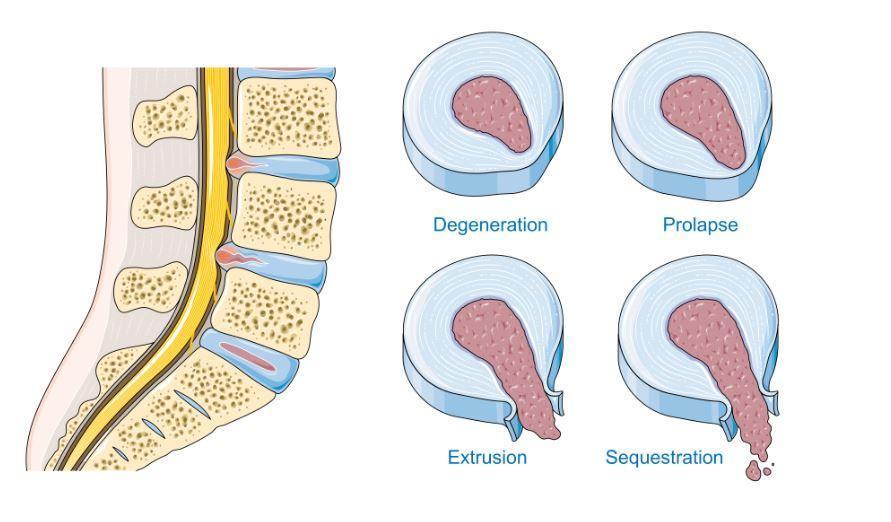
Herniated Discs: What Is Actually Happening in the Back?
© Laboratoires Servier, CC BY-SA 3.0, via Wikimedia Commons

Each intervertebral disc acts as a shock absorber. It absorbs impact, distributes mechanical loads, and maintains enough space between the vertebrae for the nerve roots to pass through.
The disc has two main components:
- a strong outer fibrous ring;
- an inner gel-like core called the nucleus pulposus.
The nucleus pulposus gives the disc its flexibility and elasticity.
A herniated disc occurs when the outer fibrous ring tears—because of progressive degeneration, an awkward movement, or excessive strain—and the nucleus pulposus protrudes outward.
When this protrusion compresses a nerve root, symptoms can appear, including:
- lower back or neck pain, which may be very intense;
- pain that radiates into the leg, known as sciatica, or into the arm, known as cervical radiculopathy;
- numbness, tingling, or muscle weakness in the affected limb.
The vertebral levels most commonly affected in the lower back are L4-L5 and L5-S1, which are responsible for most cases of sciatica. In the neck, the C5-C6 level is most commonly involved, with symptoms radiating into the shoulder, arm, or fingers.
However, a herniated disc is not necessarily a permanent condition. In many cases, the herniated tissue is naturally reabsorbed over several weeks or months as the body removes the excess material and inflammation decreases.
A well-managed conservative treatment plan—particularly physiotherapy—can significantly accelerate this process.
Physiotherapy and Herniated Discs: How Does It Work?

[Image source: https://www.magnific.com/free-photo/front-view-senior-couple-worried_5340480.htm#fromView=search&page=1&position=11&uuid=357f1233-ef76-4fe6-96de-f58c804dad35&query=hernie+discale]
Physiotherapy is a structured clinical approach. The physiotherapist first carefully evaluates the patient’s condition before developing a treatment plan suited to their individual needs.
The Initial Assessment: An Essential Starting Point
The physiotherapist works to identify the affected vertebral level, the nature and pattern of the pain, and whether it is mechanical, inflammatory, centralized, or radiating.
They also assess any neurological deficits and the patient’s functional limitations. This assessment guides the entire treatment process and allows the physiotherapist to choose and adjust techniques according to each patient’s clinical condition.
Manual Therapy and Spinal Decompression
Several manual therapy techniques may be used from the beginning of treatment to reduce muscle tension and improve joint mobility.
Traction therapy for spinal decompression can be particularly effective in treating herniated discs. By creating more space between the vertebrae, it reduces pressure on the disc and the compressed nerve root.
Some patients experience relief during the first few sessions, encouraging them to remain committed to the rest of the treatment plan.
The McKenzie Method: Centralizing the Pain
The McKenzie Method is a well-established rehabilitation approach used to treat herniated discs.
It is based on repeated directional movements, often involving spinal extension, to centralize the pain. In practical terms, the objective is to move the pain away from the affected limb and back toward the spine. This can be a sign that pressure on the nerve root is decreasing.
When a patient responds well to this approach, progress can be rapid, with encouraging results appearing within the first few weeks.
Strengthening the Deep Core Muscles
One of the foundations of physiotherapy treatment is strengthening the core—the deep muscles that stabilize the spine.
These muscles include:
- the transverse abdominal muscle;
- the multifidus muscles;
- the pelvic floor muscles.
Together, these muscles form a natural support belt around the spine.
When they are underdeveloped or inhibited by pain, the spine does not receive adequate support. This increases the strain placed on the intervertebral discs.
Gradually strengthening these muscles is essential for stabilizing the spine over the long term and reducing the risk of recurrence.
Postural Rehabilitation
Physiotherapy also includes an important educational component.
Patients learn to recognize the postures and movement patterns that repeatedly overload the affected disc. These may include prolonged sitting, lifting heavy objects, or certain sports activities.
Integrating this awareness into daily life can permanently change the way a patient moves and considerably reduce the risk of recurrence.
When Is Surgery Really Necessary?
Signs of a Surgical Emergency
The most serious condition is cauda equina syndrome. This occurs when the sacral nerves are severely compressed, resulting in a loss of bladder or bowel control.
It may also be accompanied by a loss of sensation in the perineal region and inner thighs.
In this situation, every hour matters. Cauda equina syndrome is a surgical emergency.
Progressive Neurological Deterioration
If a patient experiences a progressive loss of muscle strength or worsening sensory deficits despite receiving appropriate conservative treatment, surgery may be necessary to prevent permanent damage.
Regular monitoring by both the physiotherapist and physician makes it possible to identify this deterioration in time.
Failure of Conservative Treatment
When physiotherapy and other conservative measures have not produced satisfactory improvement after 6 to 12 weeks of properly followed treatment, a surgical assessment may be appropriate.
It is important to allow this amount of time. It gives the body an opportunity to respond to treatment and confirms that conservative options have been properly explored.
Even so, the statistics speak for themselves: 80% to 90% of patients with a herniated disc recover without surgery.
The decision to undergo surgery should never be taken lightly. A complete medical evaluation—including diagnostic imaging and an assessment by a specialist—is essential before proceeding.
What Physiotherapy Provides That Surgery Cannot Replace
Surgery may remove the herniated portion of the disc, but it cannot correct muscle imbalances, retrain movement habits, or guide the patient toward a sustainable return to an active lifestyle.
This is precisely where physiotherapy is irreplaceable.
Preventing Recurrence Through Long-Term Muscle Strengthening
A patient who undergoes surgery and returns to normal activities without strengthening their muscles or changing their postural habits may face a high risk of recurrence.
The herniation may return at the same vertebral level or develop at an adjacent level.
Physiotherapy directly addresses these risk factors by helping the patient build a spine that is better supported and used more effectively over the long term.
Retraining Everyday Movement Habits
Physiotherapy incorporates postural guidance into everyday movements, including:
- how to sit at a desk;
- how to bend down to pick up an object;
- how to carry a load;
- how to sleep.
When these adjustments are repeated until they become automatic, they continuously reduce strain on the discs, long after the treatment period has ended.
No Surgical Risks
Physiotherapy is a completely non-invasive approach. It does not involve the risks associated with surgery, such as:
- postoperative infection;
- complications related to general anesthesia;
- persistent pain at the incision site;
- scar tissue reactions or fibrosis.
A Safe and Structured Return to Work and Sports
The return to professional and athletic activities takes place gradually, according to a safe and structured plan.
The physiotherapist guides the patient through every stage, adjusts exercises according to the patient’s actual level of recovery, and prevents them from returning too quickly in a way that could compromise their progress.
Helping Patients Take an Active Role in Their Recovery
One of the most valuable aspects of physiotherapy is the independence it gives patients.
By understanding their body, learning how to perform their exercises, and developing new habits, patients are no longer passive in the management of their condition.
They become active participants in their recovery, which is one of the most important factors for long-term success.
When Should You See a Physiotherapist for a Herniated Disc?
You do not need to wait until the pain becomes unbearable—or even until a herniated disc has been confirmed through diagnostic imaging—to see a physiotherapist.
Early treatment generally produces better results and can often prevent the condition from getting worse.
You should consult a physiotherapist if you experience:
- lower back or neck pain that persists for more than a few days;
- pain that radiates into the arm or leg, such as sciatica or cervical radiculopathy;
- loss of strength, numbness, or tingling in a limb;
- functional limitations affecting your work, sleep, or daily activities.
If a herniated disc has been confirmed through diagnostic imaging, an appropriate treatment plan can begin without delay.
Our physiotherapists can assess your condition and develop a personalized treatment plan as soon as the first symptoms appear.
FAQ
Can a Herniated Disc Heal Without Surgery?
A herniated disc may be partially or completely reabsorbed over time.
Physiotherapy can accelerate this process by reducing inflammation and stabilizing the spine. A full recovery without surgery is possible for 80% to 90% of patients.
Physiotherapy follow-up can help optimize recovery and prevent recurrence.
How Long Does Physiotherapy Treatment for a Herniated Disc Take?
The length of treatment varies according to the severity of the symptoms and the patient’s response to treatment:
- some patients experience significant improvement within four to six weeks;
- others require three to six months of follow-up to achieve a full recovery.
Continuing to perform exercises at home plays an important role in the overall recovery time.
Can You Continue Working With a Herniated Disc?
In most cases, yes, although certain adjustments may be required:
- physiotherapy can help identify postures and activities that should be temporarily avoided;
- ergonomic adjustments to the workstation may be recommended;
- a gradual return to physically demanding tasks can be planned according to the progression of symptoms.
Is Physiotherapy Painful When You Have a Herniated Disc?
No. Treatment is adjusted to the patient’s tolerance at every stage:
- the techniques are intended to reduce pain, not make it worse;
- some exercises may cause mild discomfort at the beginning of treatment, which can be normal;
- the physiotherapist continuously adjusts the intensity of the treatment according to the patient’s response.
Feature Image by: © Laboratoires Servier, CC BY-SA 3.0, via Wikimedia Commons
Author
-

We are physiotherapists passionate about movement and rehabilitation, with a clear goal: helping people better understand their pain and return to an active, unrestricted life.
Through our practice and content, we share practical, science-based approaches to prevent injuries, relieve pain, and sustainably improve mobility. We believe that well-informed patients make better decisions and achieve better outcomes.

Richard Bouzaglou, B.Sc. PT
Physiotherapist | Co-Founder
An experienced professional, Richard is the co-founder of the AMS Medical and Rehabilitation Center, where he has played a key role since 2008. With a background in sports medicine and physiotherapy, he has developed strong clinical expertise, particularly working with elite athletes.
His practice is based on a comprehensive approach that integrates advanced manual therapy, functional rehabilitation, and personalized care. Committed to continuous education and mentoring students, he is known for his clinical rigor and his ability to build lasting, trust-based relationships with his patients.

Moshe Vazana
Physiotherapist
With over 15 years of experience, Moshe is recognized for his precise, evidence-based approach. A physiotherapy graduate with advanced training in several methodologies, including the McKenzie Method (MDT) and the Mulligan Concept, he specializes in treating musculoskeletal and spinal conditions.
His international background and commitment to excellence enable him to provide care that is tailored, effective, and sustainable. Passionate about knowledge sharing, he is also actively involved in training the next generation of physiotherapy professionals.
Recent Comments