
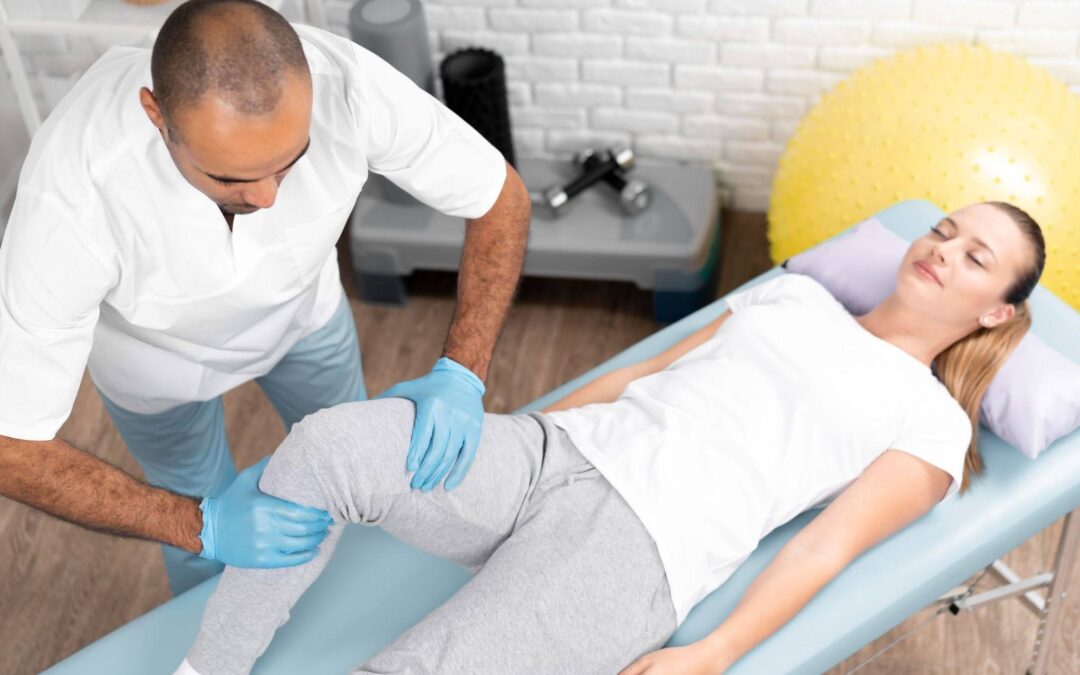
Pelvic physiotherapy helps women who run reduce urinary leakage through pelvic floor rehabilitation, enabling them to better manage the pressure generated during exercise.
Specifically, it focuses on three key areas:
- strengthening the pelvic floor muscles,
- improving their coordination with breathing and the abdominal muscles,
- controlling intra-abdominal pressure while running.
In the context of running, these symptoms most often occur during repetitive impacts, changes in pace, or periods of fatigue. The purpose of rehabilitation is, therefore, to work directly on the body’s dynamic function.
What Is Pelvic Physiotherapy?
For many female runners, urinary leakage occurs only during physical exertion or high-intensity activity. Pelvic physiotherapy specifically addresses real-life movement, not just theory.
Rather than simply strengthening an isolated muscle, it helps the body relearn how to manage pressure and coordination while running. It is a comprehensive approach to movement organization in which multiple systems work together.
Through this global approach, pelvic physiotherapy:
- improves pelvic floor response during repetitive impacts,
- synchronizes breathing, abdominal muscles, and the pelvic floor during exercise,
- distributes the internal pressures generated by running more effectively,
- stabilizes the trunk during demanding phases (acceleration, uphill running, fatigue),
- gradually reintroduces running without fear or apprehension.
This work resembles motor learning, which is essential because running involves thousands of repetitive impacts during which the body must react within milliseconds. Conscious voluntary control becomes ineffective during periods of high intensity or fatigue.
Urinary Leakage: Should You Stop Running?
In most cases, completely stopping running is not the recommended solution without a professional assessment. Exercise-related urinary leakage is generally a sign that adaptation is needed, not a reason to stop running.
In practice:
- continuing to run is often possible,
- adjusting training intensity and exercise types is sufficient in many cases,
- maintaining physical activity helps preserve overall abilities, particularly coordination and deep muscle tone.
Pelvic physiotherapy therefore provides a structured and progressive framework for returning to running. Completely stopping activity without an assessment can sometimes slow functional recovery because the body loses important movement references.
Maintaining an adapted level of activity, on the other hand, helps preserve stabilization patterns. The neuromuscular system operates on the principle of adaptation: it retains what is used and gradually loses what is no longer used.

What Happens in the Body of a Woman Runner Experiencing Urinary Leakage?
During running, the body experiences repetitive impacts and rapid changes in pressure. When leakage occurs, it is not simply a matter of weakness; it is often a matter of timing and coordination.
With each stride, a brief increase in abdominal pressure is generated. The pelvic floor must react instantly to contain this pressure.
When fatigue sets in, this response becomes less rapid or less precise. Coordination between breathing and core stabilization can become disrupted. The higher the intensity, the smaller the margin for control.
Certain situations make this imbalance more common:
- the postpartum period,
- high training loads,
- general fatigue or insufficient recovery.
Urinary leakage is not a static condition; it tends to occur under specific loading and stress conditions.
This variability explains why symptoms may seem irregular or unpredictable. One training session may be completely controlled, while another may trigger leakage solely because of a different fatigue level or training intensity.
10 Real-World Situations Where Urinary Leakage Occurs
Exercise-related urinary leakage mainly occurs when several stressors combine: intensity, impact, and neuromuscular fatigue.
It is typically observed:
- during a final sprint or sudden acceleration,
- during interval training sessions,
- when running uphill or on inclines, where the effort is more demanding,
- at the end of a long run, when fatigue accumulates,
- during HIIT workouts involving repeated impacts,
- when returning to running after pregnancy,
- during exercises that include jumping movements,
- after an injury or a period away from sports,
- during periods of general fatigue (stress, lack of sleep, overload),
- during competitions, under maximum intensity and psychological pressure.
These situations are not random. They correspond to contexts in which biomechanical demands temporarily exceed the coordination capacity of the deep stabilizing system.
With appropriate training, it is possible to gradually increase tolerance to these situations without symptoms occurring.
When Should You Consult a Pelvic Physiotherapist?
Certain situations indicate that simple training adjustments are no longer enough. Pelvic physiotherapy becomes relevant as soon as symptoms begin to affect sports participation, even mildly.
It is recommended to consider a consultation if you experience:
- repeated urinary leakage while running or exercising,
- discomfort that affects performance or confidence during movement,
- a sensation of pelvic heaviness after training,
- a gradual and unintentional reduction in activity (decreasing distance or intensity to avoid symptoms),
- a return to sports after pregnancy without improvement over time,
- persistent symptoms despite performing exercises independently.
The key concern is not the severity of the symptoms, but their recurrence and their impact on athletic participation.
Early intervention helps prevent the development of compensatory strategies, such as excessive activity reduction or unintentional changes in running mechanics. The earlier the assessment is performed, the faster and more effective functional recovery tends to be.
A consultation also helps identify the factors contributing to symptoms. Not all urinary leakage experienced during running is caused by the same mechanism.
For some athletes, the issue is primarily related to intra-abdominal pressure management, while for others, fatigue, breathing habits, or certain movement patterns play a more significant role.
The goal of a pelvic physiotherapy assessment is to understand how the body responds during exercise, enabling interventions tailored to each runner’s situation. An individualized approach helps avoid generic solutions that do not always address the specific needs of every athlete.
FAQ
Can I Continue Running During Pelvic Floor Rehabilitation?
Yes, in most cases. Running does not necessarily need to stop, but it should be adjusted according to your symptoms.
In practice, this may include:
- reducing intensity (less interval training or hill work initially),
- gradually increasing running volume,
- performing rehabilitation exercises alongside running,
- adjusting training based on the body’s response after exercise.
Why Do I Only Experience Leakage During Certain Types of Runs (Intervals, Hills)?
Because certain types of exercise place significantly greater demands on the pelvic floor.
These situations combine:
- stronger impacts (sprints, jumps, accelerations),
- rapid increases in abdominal pressure,
- muscular fatigue toward the end of exercise,
- reduced motor control at higher intensities.
Is This Common Among Female Athletes, or Am I an Isolated Case?
It is common, but often underreported.
Many female athletes:
- experience these symptoms without talking about them,
- silently adapt their training,
- assume it is normal after pregnancy or intense sports participation,
- are unaware that effective treatment options exist.
Does Pelvic Physiotherapy Work Even If I’ve Had Leakage for a Long Time?
Yes. The duration of symptoms does not eliminate the possibility of improvement.
Treatment can still improve:
- muscular strength,
- pelvic floor coordination,
- pressure management during exercise,
- movement habits related to running.
Will Urinary Leakage During Running Get Worse If I Keep Running?
Not necessarily. Running does not automatically worsen symptoms.
The risk mainly increases when:
- symptoms are not professionally assessed,
- no training or rehabilitation adjustments are implemented,
- fatigue or training overload continues,
- the pelvic floor remains untrained or poorly coordinated.
From both a performance and health perspective, the goal is not only to eliminate symptoms but also to restore a stable capacity to manage the demands of running effectively.
Author
-
We are physiotherapists passionate about movement and rehabilitation, with a clear goal: helping people better understand their pain and return to an active, unrestricted life.
Through our practice and content, we share practical, science-based approaches to prevent injuries, relieve pain, and sustainably improve mobility. We believe that well-informed patients make better decisions and achieve better outcomes.

Richard Bouzaglou, B.Sc. PT
Physiotherapist | Co-Founder
An experienced professional, Richard is the co-founder of the AMS Medical and Rehabilitation Center, where he has played a key role since 2008. With a background in sports medicine and physiotherapy, he has developed strong clinical expertise, particularly working with elite athletes.
His practice is based on a comprehensive approach that integrates advanced manual therapy, functional rehabilitation, and personalized care. Committed to continuous education and mentoring students, he is known for his clinical rigor and his ability to build lasting, trust-based relationships with his patients.

Moshe Vazana
Physiotherapist
With over 15 years of experience, Moshe is recognized for his precise, evidence-based approach. A physiotherapy graduate with advanced training in several methodologies, including the McKenzie Method (MDT) and the Mulligan Concept, he specializes in treating musculoskeletal and spinal conditions.
His international background and commitment to excellence enable him to provide care that is tailored, effective, and sustainable. Passionate about knowledge sharing, he is also actively involved in training the next generation of physiotherapy professionals.
Recent Comments